Last updated November 2026.
The best merchandise company for your business is the one that can show you, before you pay, that it will get the details right. Look for a written quote with every cost included, a digital proof of your logo on the actual product, a physical sample when the order is large or unusual, a confirmed delivery date and one person you can call when something goes wrong. The price per item matters less than most buyers expect. The costly mistakes in merchandise are wrong colours, late deliveries and products that end up in a drawer, and a cheap quote can't fix any of them.
This guide covers each stage of an order, the questions worth asking at each one and the warning signs to watch for. Crest Promos is a merchandise supplier, so we have an interest in the answer. We've written the checks so they work with any supplier, and under each stage we explain how we handle it so you can hold us to the same standard. If you're still building a shortlist, start with our guide to finding a reliable branded merchandise supplier.
"Most buyers ask for a price first. I'd rather they asked what happens if the order arrives wrong, because the answer tells you how that company works when it counts."
Jerome Abrahams, owner, Crest Promos
Start with a short brief
You can only compare suppliers fairly if each one is quoting on the same job. Before you contact anyone, write down a few lines covering:
- The purpose, such as a trade show giveaway, new staff welcome packs, a client Christmas gift or uniforms for a team
- Who will receive the items and roughly how many people
- The date the items need to be in your hands, and where they need to be delivered
- Your budget, either per item or in total
- Your logo files and brand colours, ideally with Pantone references
- Anything that's essential, such as Australian-made stock, recycled materials or individual packaging
Send the same brief to every supplier you're considering. A good supplier will come back with questions about it, such as whether the date is fixed or whether your logo works at small sizes. A supplier that sends a price without asking anything is guessing.
Checking a supplier at each stage of an order
Every merchandise order goes through the same stages, from quote to delivery and, if you're happy, a reorder. Each stage is a chance to see how a supplier really works.
The quote
A useful quote lists the product, colour, quantity, decoration method, number of print colours or stitch count, setup costs, freight and GST, with a total you can compare. Ask whether the price includes delivery to your address, how long it's valid for and what happens to the price if you change the quantity.
Be wary of a low price per item with setup, freight or "artwork" charges added later, and of quotes that don't name the decoration method. Screen printing, embroidery, pad printing and laser engraving cost different amounts and look different, so two quotes using different methods aren't comparable.
The promotional products range
A large catalogue is useful, but only if someone helps you choose from it. Ask the supplier which products they'd recommend for your purpose and budget, and why. You want ideas and reasons, along with the product links. Ask which items are held in Australian stock and which are made to order overseas, because that changes the lead time by weeks.
A warning sign is a supplier who recommends whatever has the highest margin, or who can't tell you how a product holds up after months of use. Products people keep tend to be practical for daily use. Drinkware, umbrellas, quality pens, well-made apparel and everyday-carry items give your logo a longer life than novelty items that break. Notebooks also work well for conferences, trade shows, team packs and customer campaigns, and bags and apparel are highly visible, so they keep your brand in front of more people.
The proof
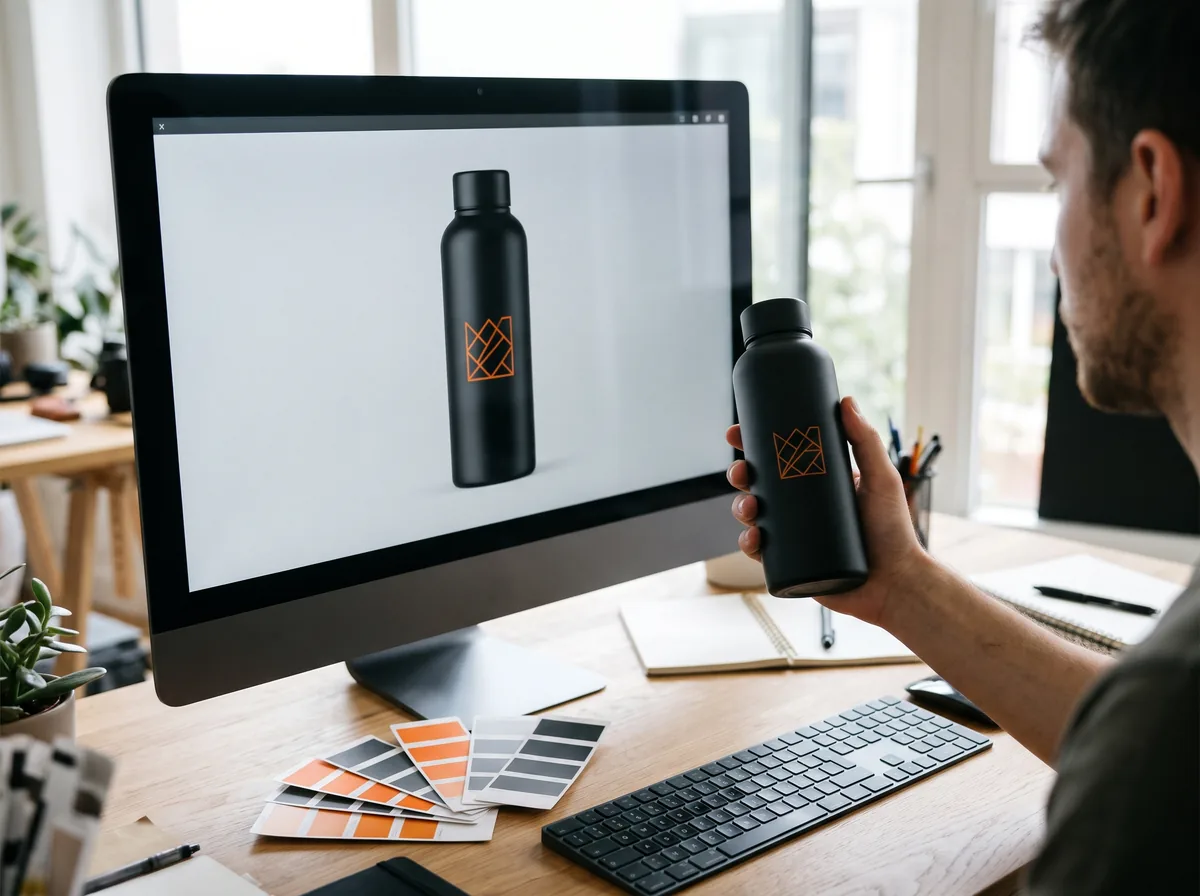
A digital proof shows your logo on the product at its actual size and position, with the colours and decoration method listed. Check the spelling, the logo size and position, the colours against your Pantone references and anything else printed, such as a phone number or web address. Nothing should go into production until you've approved a proof in writing.
Be cautious of any supplier who offers to skip the proof to save time, or who charges extra for one.
The sample
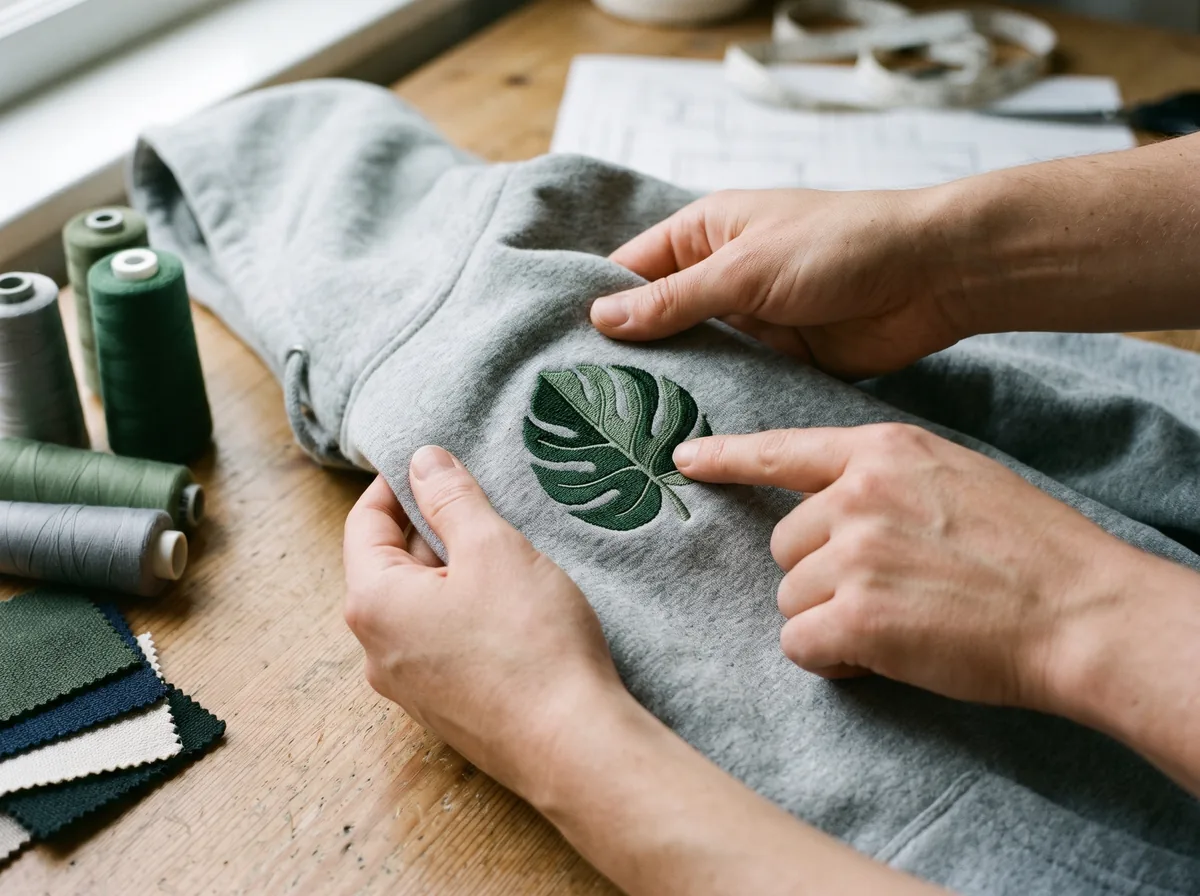
For large orders, apparel or anything you haven't ordered before, a physical sample shows you what a screen can't, such as the feel of a fabric, the weight of a bottle or how close an embroidered colour is to your brand. Ask whether a pre-production sample is available, what it costs and how long it adds to the timeline.
Production and timing
Ask for the production time from proof approval, the shipping time and the date the goods will be at your door, all in writing. Ask what happens if a date is missed. Lead times vary a lot, from one to two weeks for printed stock items held in Australia to six to ten weeks for custom products made overseas.
A vague answer such as "usually a couple of weeks" isn't good enough when you have an event date. Neither is a supplier who only tells you about a delay after the date has passed.
Delivery and logistics support
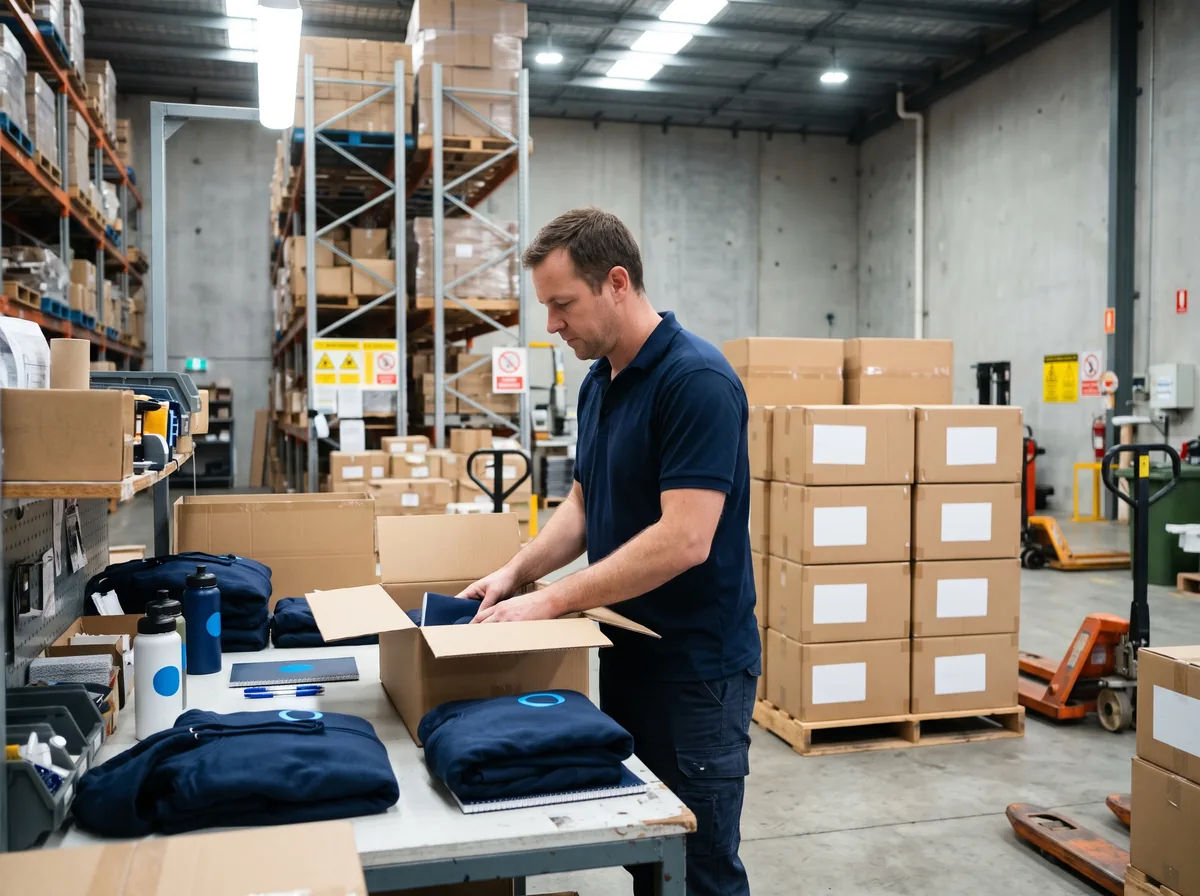
Check how the order will be packed, whether it's going to one address or several and who to call if something arrives damaged or short. For staff packs, events or rollouts across several offices, ask whether the supplier can pack by person or by site.
Problems and reorders
Even a well-run order sometimes goes wrong. Ask, before you order, what the supplier does if the print is faulty, the colour is wrong or items are missing. Under the Australian Consumer Law, goods bought for business use that cost less than $100,000 including GST come with consumer guarantees, including that they match the description and any sample. Goods bought for resupply aren't covered, so check with your adviser if that could apply to your order. A good supplier will fix the problem without you needing to quote the law.
For reorders, ask whether the supplier keeps your artwork, proofs and product details on file so the next order matches the last one exactly.
Safety, compliance and sourcing
Your logo goes on every item, so if a product is unsafe or made in poor conditions, it reflects on your business as well as the supplier. A few checks cover most of the risk.
Product safety comes first. Since 22 June 2022, mandatory standards have applied in Australia to products containing button or coin batteries, which turn up in promotional items such as light-up badges, novelty toys and some tech gadgets. The products need secure battery compartments, child-resistant packaging and specific warnings, and the ACCC has issued penalties over novelty prizes it alleged hadn't been through the required testing. If an item has a battery, a magnet or small parts, or is likely to end up with children, ask the supplier how they've checked it meets Australian standards.
For ethical sourcing, ask where the products are made and what the supplier knows about the factories, such as whether they hold an independent audit like amfori BSCI or SMETA. If your business has consolidated revenue of at least $100 million, the Modern Slavery Act 2018 requires you to report on the risks in your supply chain, and promotional products are part of that supply chain. Even below that threshold, many large clients now ask their own suppliers these questions.
Environmental claims need care as well. A product described as "eco-friendly" or "sustainable" should come with something specific, such as the percentage of recycled content or a recognised certification. The ACCC can investigate and take enforcement action over false or misleading environmental claims, and a vague claim on your merchandise is a claim your business is making too. Our guide to sustainable branded merchandise covers what to look for.
Also ask whether the supplier is a member of the Australasian Promotional Products Association (APPA), the industry body, whose code of conduct covers product safety and fair dealing.
Key benefits and common concerns when choosing a supplier
Isn't it cheaper to order from an online store?
Sometimes, for small, simple orders where you know exactly what you want. Online stores work well when the product is standard, the artwork is simple and the date isn't tight. They can also suit small businesses that need fewer items, want to avoid higher minimum order quantities or prefer print on demand. The savings shrink when you add setup and freight, and they disappear if a proof isn't checked by a person and the colours or logo position come out wrong. For anything with a fixed date, several products or more than one delivery address, a supplier with an account manager usually costs about the same and carries far less risk.
Should I buy direct from an overseas factory?
Buying direct can lower the unit price on very large runs of custom products. In return you take on the minimum order quantities, long lead times, quality checks, freight, import duties, logistics and any problems that arrive in the shipping container. Product safety is also your responsibility once you're the importer. For most businesses ordering in the hundreds or low thousands, a local branded merchandise company that manages overseas production for you is the safer option.
Is a big supplier better than a small one?
Among the top branded merchandise companies, size matters less than how your order is managed. A large supplier may have a wider range and more buying power, while a smaller, design-led one may give you more attention. Ask who will look after your order day to day, whether that person will stay the same and how quickly they reply. Then test it by sending an enquiry and seeing how long the answer takes and how useful it is. The best branded merchandise companies bring ideas and proactive advice as well as processing orders.
Can a supplier help if I don't know what I want?
A good one should start with your goal rather than a product, then recommend options that fit the goal, audience and budget. Many orders start with an aim, such as making a trade show stand busier or welcoming new staff, rather than a chosen product. Ask the supplier for ideas within your budget and for examples of what other businesses in your industry have ordered.
A scorecard for comparing suppliers
Use this table when you have quotes from two or three suppliers. Score each one from 1 to 5 against each line, based on what they've shown you rather than what their website says.
| Check | A good answer looks like | Supplier 1 | Supplier 2 | Supplier 3 |
|---|---|---|---|---|
| Response to your brief | Questions about your purpose, date and artwork before quoting | |||
| Quote | Every cost listed, including setup, freight and GST | |||
| Product advice | A short list with reasons, plus honest views on quality | |||
| Proof | Free, detailed and required before production | |||
| Samples | Available on request, with costs and timing explained | |||
| Timeline | Delivery date confirmed in writing | |||
| Delivery options | Multiple addresses, packing by person or site, stock holding | |||
| Safety and sourcing | Can say where products are made and how safety is checked | |||
| Problems | A clear answer on reprints and replacements | |||
| Contact | One named person who replies promptly | |||
| References | Clients in a similar industry or at a similar scale |
The highest total doesn't have to win. If your order is for a fixed event date, timeline and contact might matter more than the range, so weight the lines that matter most to you.
About Crest Promos
Crest Promos has supplied high quality products, uniforms and corporate gifts to Australian businesses for more than 30 years. Clients include national brands such as Meta, JCDecaux, Nutrien, White Claw and amps, along with local businesses ordering a few hundred items for an event.
Every client works with one account manager from the first quote to the reorder. Quotes and digital proofs are free. We can hold stock and pack orders by person or by site, which suits staff welcome packs, onboarding, recognition programs and uniform rollouts across several locations.
Quality matters because every item reflects the standards of the business behind it, and good merchandise leaves a stronger impression than disposable giveaways.
A typical scenario
The example below is indicative. It combines the kind of requests we see often, rather than describing one client.
A software company with offices in Brisbane, Sydney and Melbourne is hiring around 40 people in February and has a conference stand booked for March. The marketing manager sends a brief with a budget of about $120 per welcome pack, a list of start dates by office and the conference delivery address, with goals tied to brand visibility at the event, a better experience for new hires and useful items for end customers.
The account manager comes back with questions about sizing for the hoodies and whether the conference giveaway needs to fit in a satchel. The quote that follows offers two pack options at different prices, plus three giveaway ideas, with setup and freight listed for each.
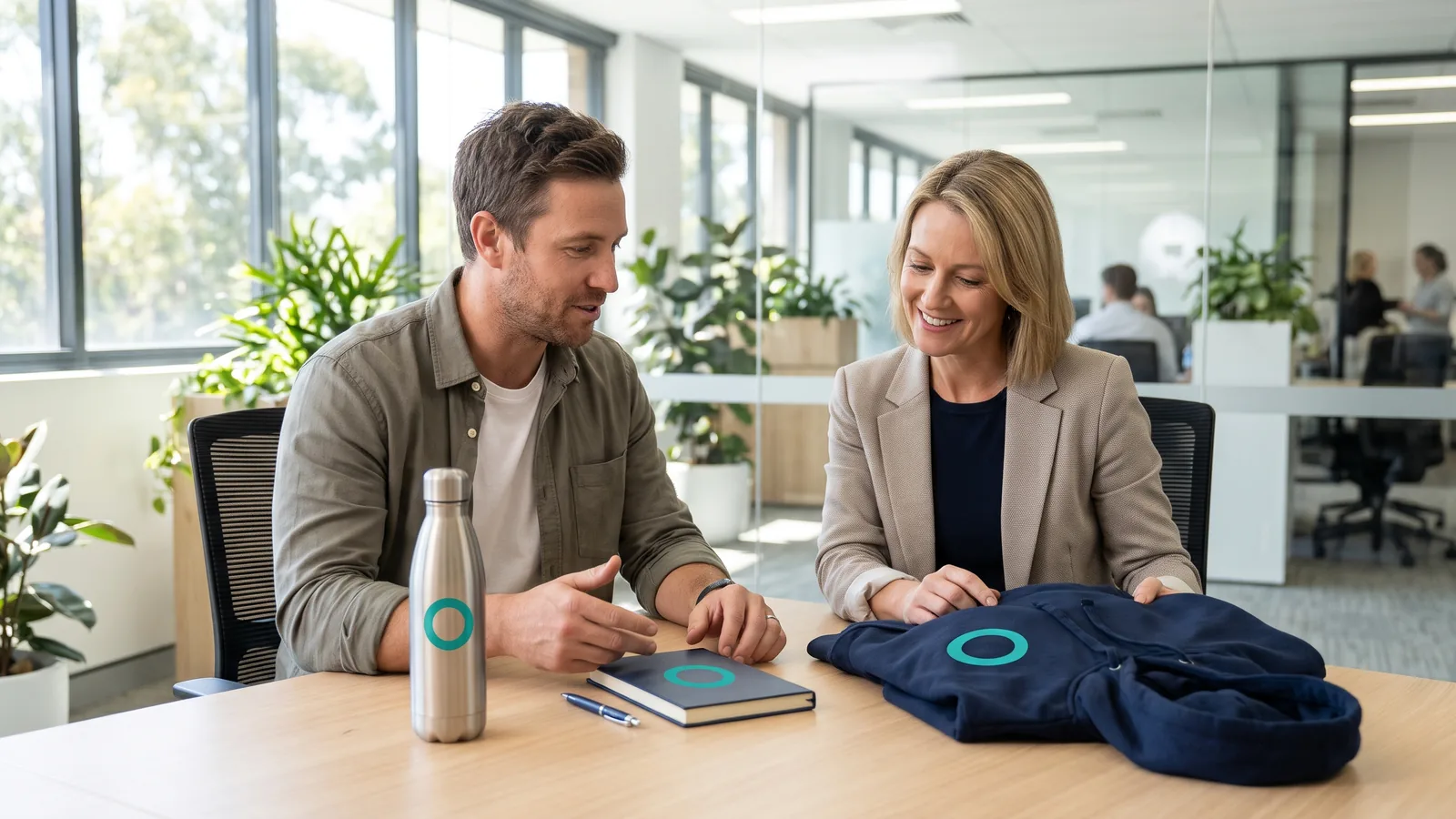
The client chooses a pack with a hoodie, drink bottle, notebook and pen. When the proofs for all four items arrive, the marketing team picks up that the logo on the bottle needs to sit higher to clear the grip, and a corrected proof follows. Because the hoodie is a new style for them, the client asks for a decorated sample before approving the full run. The bottle and notebook make sense because they slip into daily use, which keeps the company's logo in front of people over time. They also help employees feel welcomed and connected during onboarding.
Part-way through production, the drink bottle colour they chose goes out of stock with the local distributor. The account manager tells the client straight away, sends a proof of the closest available colour and confirms the original delivery date still stands. The packs are labelled by name and packed by office, and each office receives its cartons a week before the first start date. Spare packs are held in stock and sent out as later starters join.
ROI here can be tracked through usage, event engagement, onboarding feedback, reorder rates or brand recall, as well as direct sales. If the conference team wants more premium promotional gifts later, items people keep can do more for brand recognition and customer loyalty than disposable event handouts.
When the next round of hiring comes up, the reorder is a short email. The artwork, approved proofs and product codes are already on file.
"The orders I remember are the ones where something nearly went wrong, such as a carton held up in freight the week before a conference. What clients remember is that they heard about it from us first, along with a fix."
Jerome Abrahams, owner, Crest Promos
If you'd like a quote to compare against the scorecard above, send your brief through the quote form or call 1300 084 102.
Send your brief and we'll quote every cost, with a free digital proof.
About this guide
This guide is based on the questions Crest Promos clients ask most often before placing a first order, and on the problems we've been asked to fix when an order with another supplier went wrong. Legal and safety information was checked against the government and industry sources listed below in November 2026. It's general information, so check with your own advisers on legal or compliance questions for your business. We review this guide every six months and update it when rules or our processes change.
About the author
Written by Jerome Abrahams, owner of Crest Promos. Jerome has more than 30 years of experience in promotional products, uniforms and corporate gifts, supplying businesses ranging from local trades to national brands such as Meta, JCDecaux, Nutrien, White Claw and amps.
- ACCC, Businesses on notice as mandatory button battery laws commence, June 2022
- ACCC, Novelty toy supplier and the operator of Timezone, Kingpin and Zone Bowling pay penalties for alleged button battery testing non-compliance
- APPA, Promotional product safety
- APPA, Code of conduct
- Federal Register of Legislation, Modern Slavery Act 2018
- ACCC, Consumer rights and guarantees
- ACCC, Environmental and sustainability claims
- Crest Promos, Sustainable branded merchandise
- Crest Promos, What should I look for in a company uniform supplier?