Last updated November 2026.
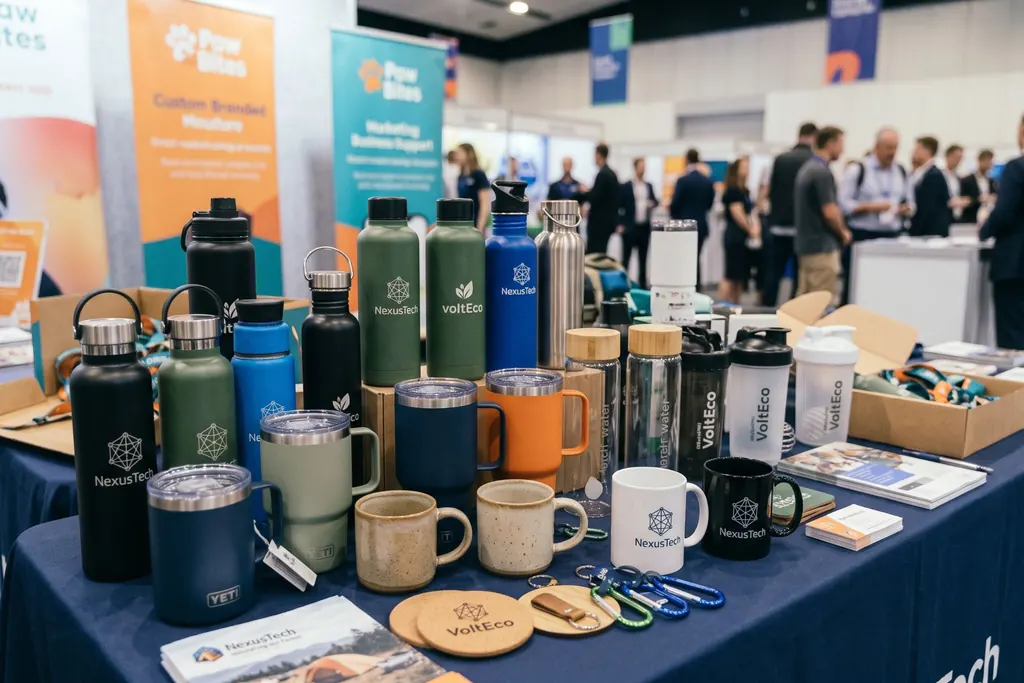
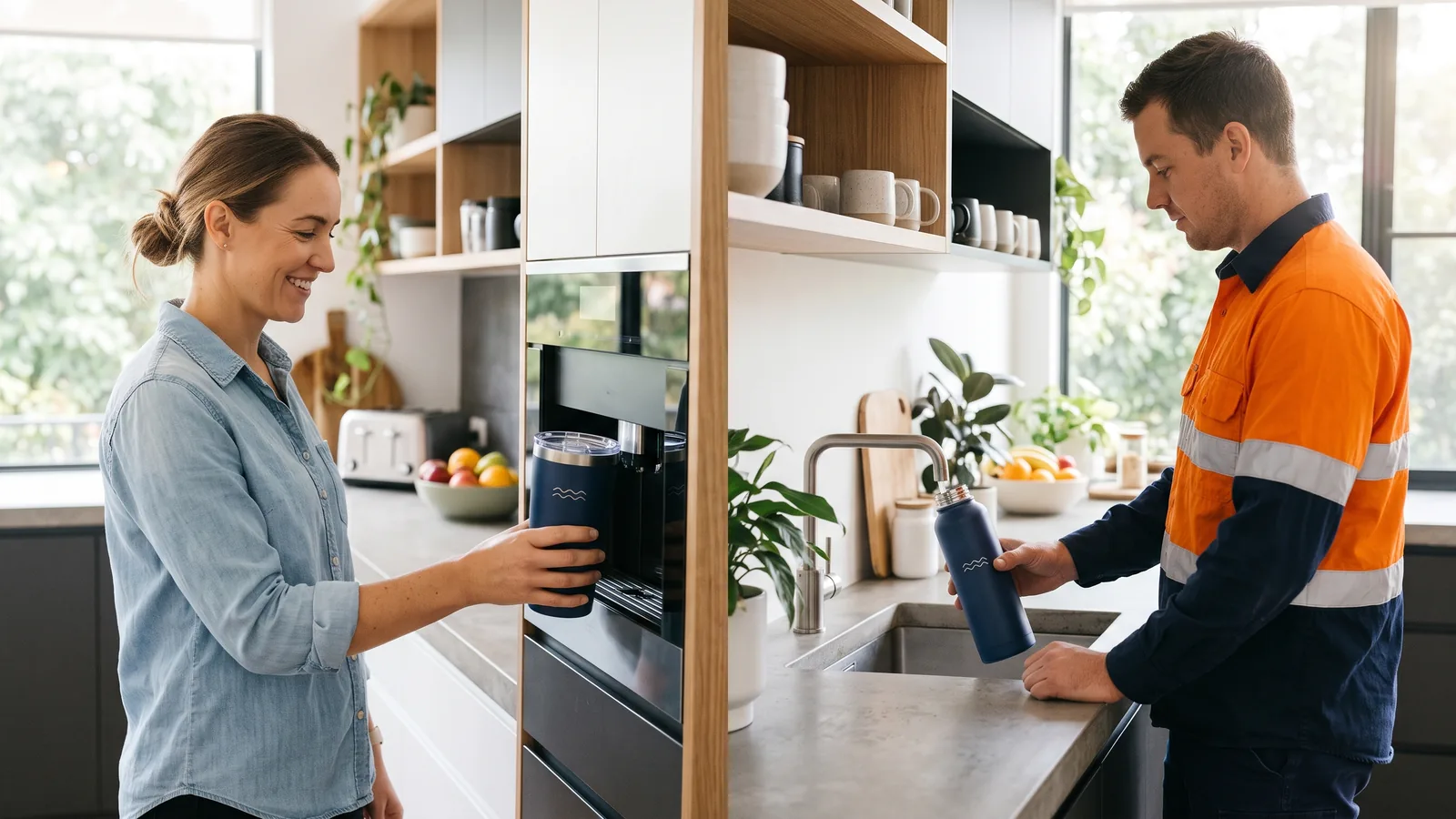
A custom stainless steel bottle suits staff who are on the move, such as people working on site, travelling between clients or heading to the gym after work, because it seals completely and can go in a bag. A tumbler suits staff whose day revolves around a desk, a car and a coffee, because it's easier to drink from, fits under most coffee machines and usually fits a car cup holder. Prices are similar for the same quality, so the choice comes down to how your team works. If your staff are split between the office and the field, offering both and letting each person choose often works better than picking one.
Both make good staff gifts when they're well made. A double-wall vacuum-insulated bottle or tumbler in 18/8 stainless steel, with a laser-engraved logo, will last for years. A cheap one with a lid that leaks or a print that wears off in the dishwasher will be in the cupboard by March.
"When a business can't decide, I suggest they ask a few staff what they'd use. A tumbler that leaks in a work bag gets left at home, and a bottle that won't fit under the office coffee machine never gets used for coffee."
Jerome Abrahams, owner, Crest Promos
Bottle and tumbler compared for corporate gifts
The table compares a typical double-wall vacuum-insulated stainless bottle and tumbler of good quality. Individual products vary, so check the specifications of the exact models you're quoted.
| Stainless bottle | Stainless tumbler | |
|---|---|---|
| Typical sizes | 500 ml to 1 litre | 350 ml to 600 ml, with larger handled styles up to about 1.2 litres |
| Lid | Screw cap, flip spout or straw lid that seals fully | Press-on or slide lid, usually splash-resistant rather than leak-proof |
| Best drinks | Water, cold drinks, sports drinks | Coffee, tea, iced drinks, smoothies |
| Carrying | Goes in a bag, backpack or side pocket on its side | Best kept upright, in a hand or cup holder |
| Coffee machine fit | Often too tall or too narrow at the mouth | Most sizes fit under a café or office machine |
| Car cup holder | Slimmer bottles fit, wider ones often don't | Most standard tumblers fit, larger handled styles may not |
| Cleaning | Narrow mouths need a bottle brush | Wide opening is easy to clean by hand |
| Logo space | Tall, curved surface suits vertical or wraparound designs | Shorter surface suits a centred logo or a name |
| Cost per item, decorated | Similar to a tumbler of the same quality | Similar to a bottle of the same quality |
The biggest practical difference is the lid. A bottle that seals completely can be thrown in a bag with a laptop. Most tumbler lids are designed to stop splashes while you walk or drive, and they'll leak if the tumbler tips over in a bag.
Matching the gift to the way your team works
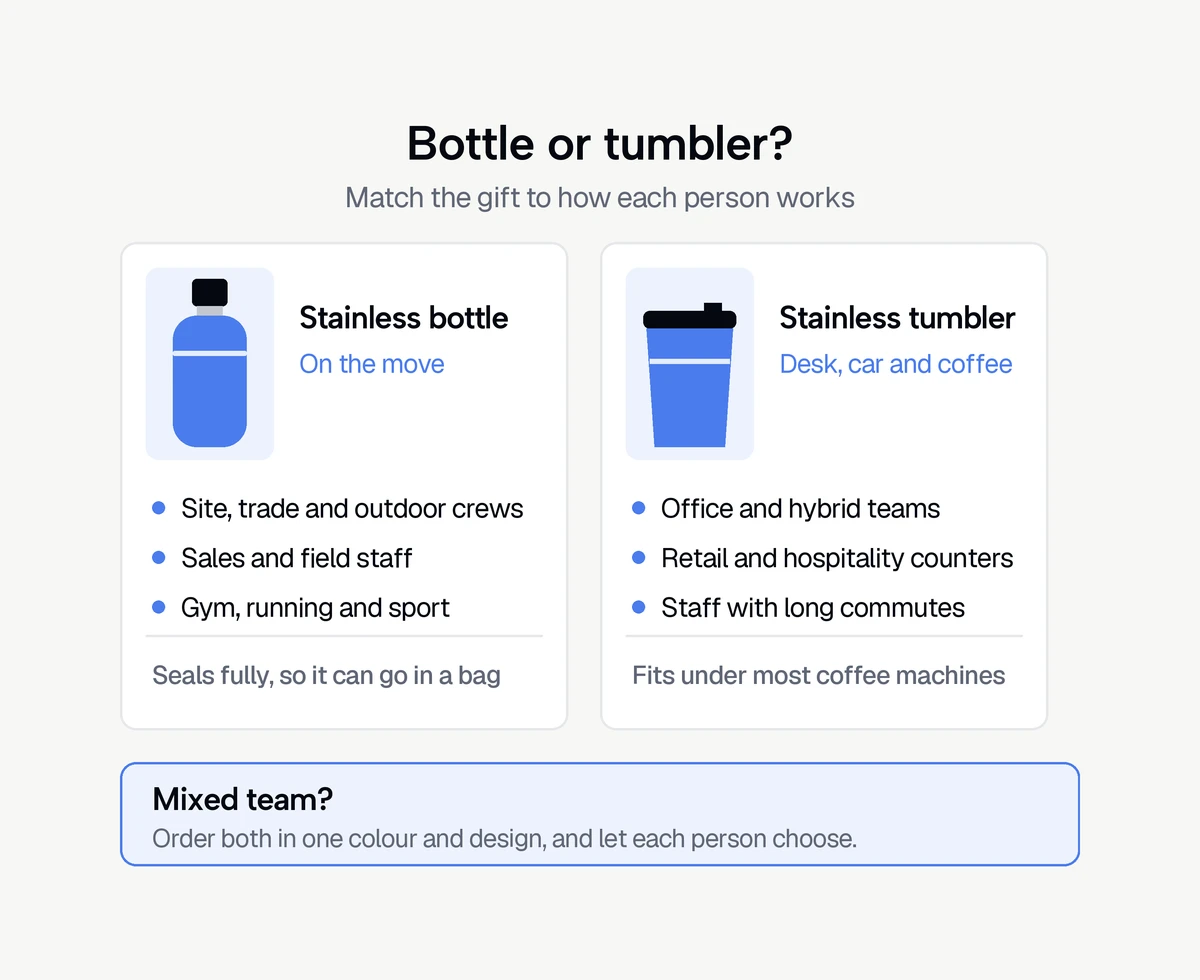
Teams that suit a bottle
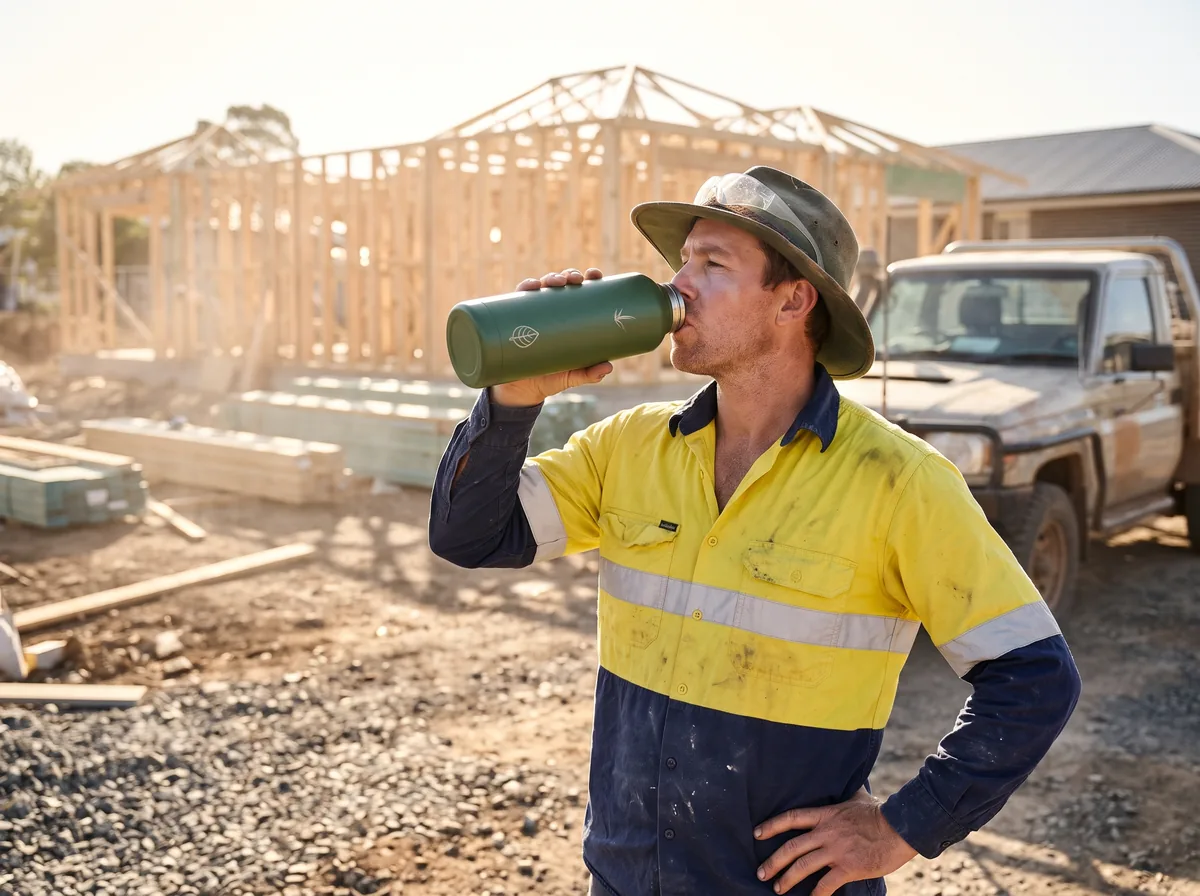
Staff who work outdoors or on site, such as trades, construction, agriculture, mining and field services, get the most from a bottle. In an Australian summer, a 750 ml or 1 litre insulated bottle keeps water cold through a long shift and can sit in a ute or a backpack without spilling. A bottle is a useful extra, but it doesn't replace the employer's duty under work health and safety laws to provide access to clean drinking water at work.
Bottles also suit sales staff and consultants who spend the day in cars and client offices, health and community workers who travel between visits, and any team with an active culture, such as a lunchtime running group or a company sports team.
Teams that suit a personalised stainless steel tumbler
Office and hybrid teams usually get more use from a tumbler. Most people at a desk drink coffee or tea through the morning. A ceramic mug suits the desk but tends to stay there, while an insulated tumbler keeps the drink at temperature, fits under the office machine and carries easily into a meeting or onto the commute. It also cuts down on disposable cups, which is worth mentioning if your business reports on waste.
Tumblers also suit customer-facing teams in retail and hospitality, who need something that sits on a counter during a shift, and staff with long commutes who want a coffee in the car.
Mixed teams
Many businesses have both, such as a head office and a warehouse, or a practice with clinic staff and visiting staff. Either of these approaches works well:
- Order both in the same colour and design, then let each person pick one through a short form before you order. This avoids waste when teams split between office and field roles, and it makes the gift feel more personal.
- Order one product for everyone and choose a style that works both ways, such as a tumbler with a sealing lid or a bottle with a wide mouth that fits ice and sits under a coffee machine.
If you ask staff to choose, set a deadline and a default for anyone who doesn't answer, so the order isn't held up.
Quality checks before you order
Two products that look identical in a catalogue photo can perform very differently. These are the checks we run on any drinkware before recommending it, and they apply whichever supplier you use.
Steel grade
Look for 18/8 stainless steel, also called 304 grade, on every surface that touches the drink. The numbers refer to roughly 18% chromium and 8% nickel, which give the steel its resistance to rust and staining. Some premium products use 316 grade, which adds molybdenum for extra corrosion resistance. It's a nice extra but rarely necessary for water and coffee. Avoid products that don't state the grade at all.
Insulation and the vacuum seal
A double-wall vacuum-insulated product keeps drinks hot or cold far longer than a single-wall one, and the outside doesn't sweat or burn your hand. Treat hot and cold hold times printed in catalogues as a guide, because they depend on the exact model, the lid and how it's used. Ask for a sample if the claim matters to you, such as for site staff working through summer.
The vacuum between the walls is sealed at the base during manufacturing. Some makers use a small amount of lead-based solder for that seal, covered by a stainless steel cap. In 2024, Stanley confirmed its tumblers used this method and said the seal is covered and doesn't touch the drink. Lead-free sealing methods are widely available, so ask your supplier how the products you're considering are sealed.
Lids and seals
The lid is where most cheap drinkware fails. Check that plastic parts are BPA-free and food grade, that silicone seals can be removed for cleaning, and that the lid matches how people will carry it. A bottle lid should be leak-proof when closed. A tumbler lid should at least be splash-resistant, with a slider that closes the drinking hole.
Coatings and cleaning
Powder-coated finishes resist chips and scratches better than standard paint and take a laser engraving well. Many insulated products are labelled hand wash only, because high dishwasher heat can damage coatings and seals over time. If your staff will put them in the office dishwasher anyway, ask for a product that's rated dishwasher safe and check the care instructions before you order.
Documentation
A good supplier can tell you where the product is made and provide food-contact test reports for the materials, such as tests to US FDA or European standards. Australia's food standards don't set a list of approved materials for drinkware, so these reports are the most reliable evidence that the steel and plastics are suitable for food and drink.
Branding and personalising
The decoration method affects how the gift looks on day one and how it looks after a year of washing.
| Method | How it looks | Durability | Best for |
|---|---|---|---|
| Laser engraving | Logo etched into the coating or steel, usually showing silver or a lighter tone | Very high, won't peel or wash off | One-colour logos, names, a premium finish |
| Pad printing or screen printing | Logo printed in one or more ink colours | Good, but can wear with heavy dishwasher use | Logos that need specific brand colours |
| UV full-colour printing | Full-colour images and gradients | Moderate, depends on the product and ink | Detailed artwork and photos |
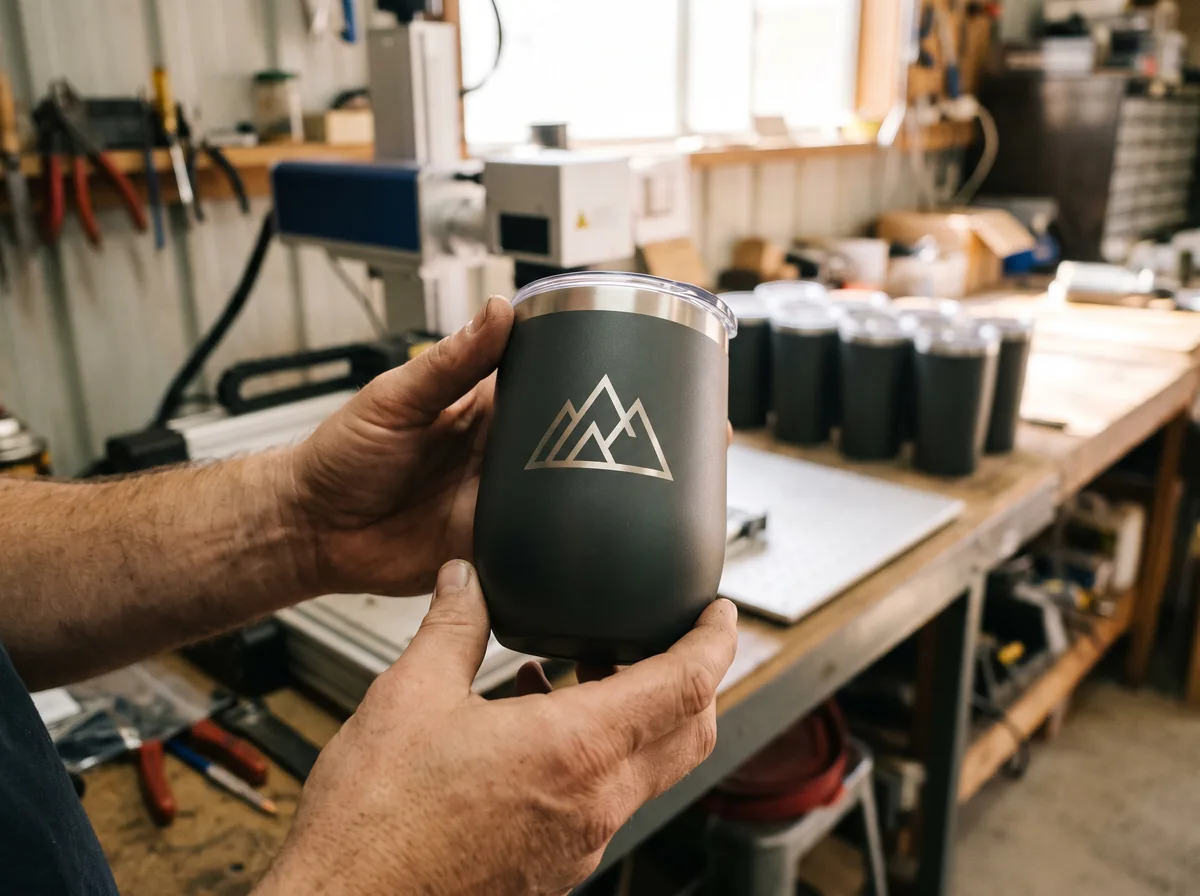
For staff gifts, laser engraving is usually the best choice. It creates a permanent mark on coated or stainless steel drinkware, suits most logos, lasts as long as the product and makes even a mid-priced bottle look like a considered gift. If your logo relies on a particular colour, choose a product colour that matches your brand and engrave the logo, or use printing and accept that it may wear faster.
Adding names with laser engraving
Engraving each person's name, usually on the opposite side to the logo, adds a personal touch and is the single easiest way to make drinkware feel less like merchandise and more like a gift. It also stops bottles going missing from the office kitchen. Names add a small cost per item and a little time to production, and both are shown on your quote. Supply names in a spreadsheet, check the spelling with each manager and approve the proof for every name, not just a sample of them.
Logo placement and size
On a bottle, a vertical logo or one placed lower on the body is easier to see when the bottle is in someone's hand. On a tumbler, a centred logo opposite the handle or straw is the standard choice. Keep fine detail and small text to a minimum, because thin lines, very small text and tight spacing can get lost when engraved or printed on a curved surface.
Packaging and presentation
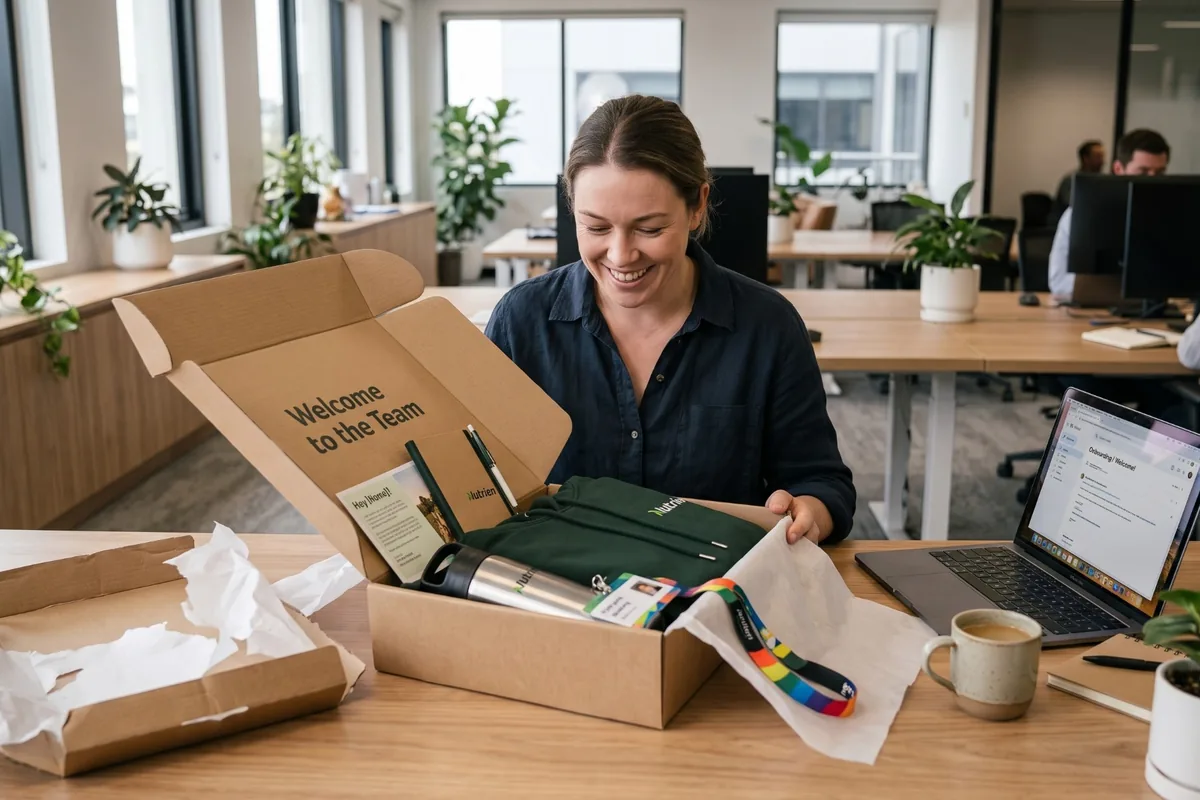
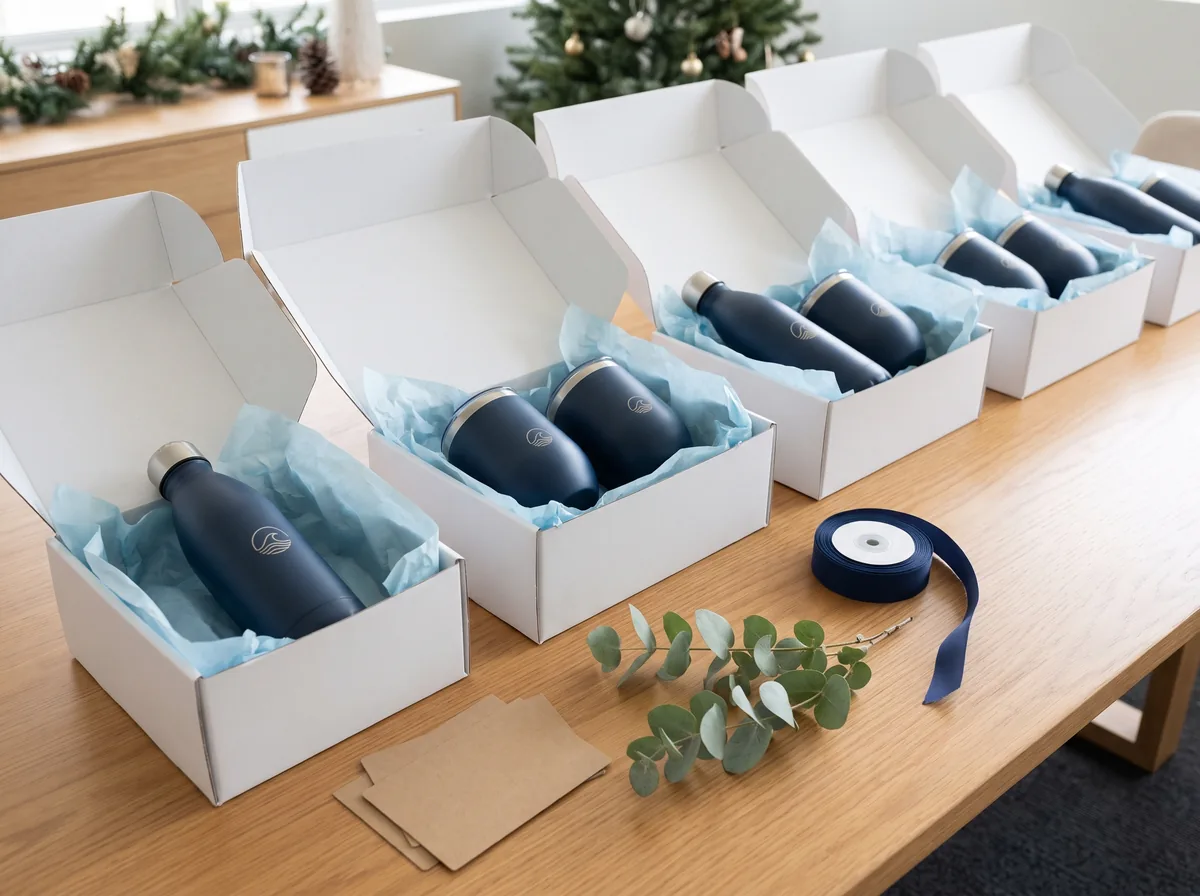
Individual gift boxes with a card look far more considered than items packed in a plain carton. For Christmas or milestone gifts, ask about individual boxes, tissue wrap or a printed sleeve, and whether the supplier can add a note from the CEO or team leader. If you're sending gifts to staff who work remotely, ask for each one to be packed and posted to the person's address.
Budget, quantities and timing
Setting a budget
For a staff gift, set the budget per person first, then choose the best bottle or tumbler for your team's routines within it. Products from well-known drinkware brands cost more than supplier-brand products of a similar build, and names and individual gift boxes each add a little per item. Prices drop as quantities rise, so a 200-person order costs noticeably less per item than a 30-person one. If a recognised name matters for the gift, here are the brands we stock, many of which can carry your logo.
Spend at the level where the product feels like a gift. Staff can tell the difference between something chosen for them and something left over from a trade show, and a slightly smaller order of better products usually lands better than a cheaper option for everyone.
Order quantities
Most of our hard goods, including stock drinkware, start at 50 units, and some styles go lower. Custom colours and products made to order overseas have much higher minimums. Order a few more than your headcount to cover new starters, a damaged item or a forgotten name. Your supplier may be able to hold the spares for you.
Timing for Christmas
Work backwards from the date you want to hand the gifts out. A typical timeline for engraved stock products held in Australia looks like this:
- Final numbers, product choice and names: at least four weeks before handover
- Proof approval: within a day or two of receiving it
- Production and engraving: our standard turnaround is 10 to 14 business days from proof approval
- Delivery: allow extra time for regional areas and the December freight rush
Christmas production is subject to stock availability, artwork approval and December freight delays. Custom colours and products made overseas take months rather than weeks, so for Christmas they need to be ordered well ahead. If it's already November, choose products held in local stock and confirm the delivery date in writing before you approve the proof. If names, complex artwork or multiple delivery addresses are involved, request a proof early. Our Christmas gifts page has more ideas for this season.
Tax
The ATO says you don't pay fringe benefits tax on a Christmas gift to an employee if it's worth less than $300 per person and it would be unreasonable to treat it as a fringe benefit. A branded bottle or tumbler, even with a name and gift box, will normally sit well below that. Ask your accountant how the cost should be treated for income tax and GST in your business.
Frequently asked questions
Do staff prefer bottles or tumblers?
It depends on the team. Office staff tend to use tumblers more because of coffee, while field and outdoor staff tend to use bottles. If you're unsure, ask a few people from each part of the business, or let staff choose before you order.
Are stainless steel bottles better than plastic ones?
For a staff gift, yes in most cases. Stainless steel doesn't hold flavours or odours the way some plastics do, it lasts longer and an insulated one keeps drinks hot or cold. Plastic bottles are lighter and cheaper, which suits a corporate event giveaway more than a staff gift.
Can you put a tumbler in the dishwasher?
Some are rated dishwasher safe and many aren't. High heat can damage the coating, the lid seals and, over time, the vacuum seal. Check the care instructions for the exact product, and include a care card with the gift if it's hand wash only.
Is a handled tumbler worth the extra cost?
Large handled tumblers of around 1 litre or more are popular and they hold enough water for a whole morning. They're heavier, more expensive and often too wide for car cup holders, so they suit desk-based teams more than people who drive for work.
Should the logo be large or small?
For staff gifts, a modest logo usually works better. People are more likely to use a bottle or tumbler at the gym, at home or on the weekend if it looks like something they'd buy themselves. A smaller logo with the person's name engraved often gets more use than a large logo on its own.
Can we gift both and keep the same branding?
Yes. Most suppliers carry bottles and tumblers in matching colours and finishes, so you can use the same engraving across both and keep the set consistent.
Ordering staff drinkware with Crest Promos
Crest Promos supplies engraved water bottles and tumblers and travel mugs, many in matching colours so you can mix both in one order. Send us your headcount, budget and handover date, and we'll come back with a short list that suits your team, with every cost listed. Quotes and digital proofs are free, and you can ask about a sample before you commit. For individual names, we proof every name before engraving, and we can pack and post gifts to staff at different offices or working from home.
Our guide to the best branded drinkware for corporate gifts compares more styles if you're still deciding, or you can browse the full drinkware range.
"The feedback I hear most is about the name. People will happily carry a bottle with the company logo if their own name is on the other side, and it's the first thing they show their family."
Jerome Abrahams, owner, Crest Promos
To start, send your brief through the quote form or call 1300 084 102.
Send your headcount and date, and we'll quote bottles and tumblers with every cost listed.
About the author
Written by Jerome Abrahams, owner of Crest Promos. Jerome has more than 30 years of experience in promotional products and corporate gifts, and has supplied staff gifts to businesses ranging from small local teams to national brands such as Meta, JCDecaux, Nutrien, White Claw and amps.
The product guidance in this article is based on the drinkware Crest Promos supplies and the questions our clients ask before ordering. Tax and regulatory information was checked against the sources below in November 2026 and is general in nature, so check with your accountant or adviser for your own circumstances.
- Australian Taxation Office, Common entertainment scenarios for business
- ABC7, Stanley and other drink cups contain lead. Should you be worried?, February 2024
- Food Packaging Forum, No regulation on food packaging in Australia and New Zealand, March 2018
- Safe Work Australia, Model Code of Practice: Managing the work environment and facilities, November 2024
- Crest Promos, What is the best branded drinkware for corporate gifts?